
Introduction: The Evolution of Intelligent Computational Methods
The rapid development of computational technologies has transformed the way information is processed, analyzed, and translated into practical technological solutions. Intelligent algorithms and emerging computational frameworks are becoming essential components of modern digital environments, enabling more flexible processing strategies, improved computational organization, and advanced software capabilities.
Traditional computational approaches generally rely on predefined instructions and established processing sequences. Although these methods remain important, increasingly complex technological applications require more adaptable approaches capable of responding to changing datasets, processing conditions, and operational requirements.
Intelligent algorithms address these challenges through mathematical optimization, machine learning, computational modeling, and automated decision mechanisms. Their integration into modern frameworks creates opportunities to develop sophisticated applications across artificial intelligence, distributed computing, robotics, software engineering, and industrial automation.
Understanding these developments requires examining the theoretical principles behind intelligent algorithms as well as the computational infrastructures that support their implementation.
1. Fundamental Principles of Intelligent Algorithms
Intelligent algorithms are computational procedures designed to solve complex problems through structured information processing, optimization, and adaptive operations. They combine mathematical principles, logical operations, and computational models to identify solutions under specific constraints.
Their behavior depends on several elements, including input information, processing rules, algorithmic parameters, and evaluation criteria.
Unlike purely static computational procedures, certain intelligent algorithms can modify their internal configurations based on previous results or newly available information. This characteristic makes them particularly relevant to applications involving uncertain environments and continuously changing datasets.
1.1 Algorithmic Optimization
Optimization represents an important foundation of intelligent computation. It involves identifying suitable solutions while minimizing or maximizing a predefined objective function.
Common optimization approaches include:
Gradient-based optimization for numerical problems.
Evolutionary algorithms inspired by natural selection.
Genetic algorithms for exploring complex solution spaces.
Particle swarm optimization for collective search strategies.
Heuristic methods for solving computationally demanding problems.
These approaches are used in scheduling, resource allocation, engineering design, parameter estimation, and machine learning.
1.2 Adaptive Computational Behavior
Adaptive algorithms modify their processing strategies according to changing conditions. Their parameters can be adjusted through iterative calculations, feedback mechanisms, or learning procedures.
Adaptive behavior is particularly useful when computational systems must operate with incomplete information, variable workloads, or changing environmental conditions.
For example, an adaptive scheduling algorithm can reorganize processing priorities according to resource availability and workload distribution.
2. Machine Learning as a Computational Framework
Machine learning provides a collection of computational methodologies through which systems can identify patterns and relationships within datasets.
Rather than relying exclusively on explicitly programmed rules, machine learning models use mathematical representations to estimate relationships between input variables and expected outputs.
Three major learning approaches form the foundation of this discipline.

2.1 Supervised Learning
Supervised learning uses labeled datasets to train computational models. Each training example contains input information associated with a known output.
The model learns relationships between these elements and uses them to generate predictions for previously unseen data.
Common techniques include:
Linear and logistic regression.
Decision trees.
Random forests.
Support vector machines.
Gradient boosting algorithms.
These methods are applied to classification, regression, forecasting, and predictive modeling.
2.2 Unsupervised Learning
Unsupervised learning investigates datasets without predefined output labels. Its objective is to identify internal structures, similarities, and patterns.
Clustering algorithms, dimensionality reduction, and association analysis are frequently used in this context.
Methods such as K-means clustering, hierarchical clustering, and principal component analysis provide different approaches to organizing complex information.
2.3 Reinforcement Learning
Reinforcement learning focuses on computational agents that interact with an environment and improve their actions through feedback.
The learning process involves states, actions, rewards, and policies. The agent evaluates different decisions and progressively develops strategies intended to maximize cumulative rewards.
This approach is relevant to autonomous robotics, resource management, simulation environments, and sequential decision-making applications.
3. Neural Networks and Deep Computational Architectures
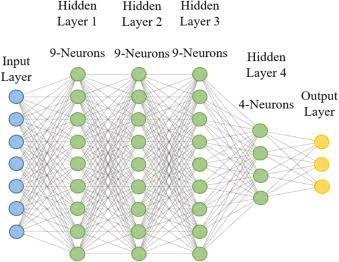
Neural networks represent another important category of intelligent computational models. Their structures consist of interconnected computational units organized into layers.
Each unit receives information, performs mathematical transformations, and transmits processed outputs to other units.
The learning process generally involves adjusting model parameters to reduce the difference between predicted and expected results.
3.1 Artificial Neural Network Structures
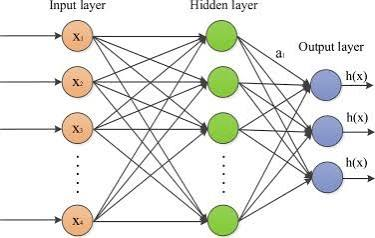
Artificial neural networks typically include:
Input layers that receive information.
Hidden layers that transform and process data.
Output layers that generate predictions or classifications.
Their performance depends on network architecture, activation functions, training procedures, and parameter configuration.
3.2 Deep Learning Architectures
Deep learning extends neural network methodologies through multiple computational layers.
Different architectures are designed for specific information-processing requirements.
Convolutional Neural Networks (CNNs) are commonly associated with image processing, visual recognition, and spatial information analysis.
Recurrent Neural Networks (RNNs) process sequential information and have historically been used for temporal data and language-related tasks.
Transformer Architectures use attention mechanisms to identify relationships between different elements of an input sequence. They are widely applied in natural language processing, computer vision, and multimodal artificial intelligence.
3.3 Model Training and Evaluation
Training intelligent computational models requires carefully organized datasets and appropriate evaluation methodologies.
Important performance indicators include accuracy, precision, recall, F1-score, computational complexity, and inference time.
Model evaluation also requires attention to overfitting, underfitting, data quality, and generalization capabilities.
These considerations help determine whether a computational model is suitable for its intended application.
4. Emerging Computational Frameworks
Computational frameworks provide structured environments for developing, testing, and deploying intelligent algorithms.
They integrate software libraries, programming interfaces, computational resources, and reusable components.
The selection of an appropriate framework depends on the algorithmic requirements, programming environment, available hardware, and intended application.
4.1 TensorFlow
TensorFlow is a computational framework designed for numerical processing and machine learning development. It provides tools for constructing neural networks, training models, and deploying computational applications.
Its ecosystem supports different development environments and hardware configurations.
4.2 PyTorch
PyTorch provides a flexible environment for developing deep learning models and conducting computational research.
Its dynamic computational graph and tensor-based operations make it suitable for experimentation, model development, and advanced artificial intelligence applications.
4.3 Scikit-learn
Scikit-learn provides machine learning tools for classification, regression, clustering, preprocessing, and model evaluation.
It is particularly useful for traditional machine learning workflows and structured data analysis.
4.4 Apache Spark
Apache Spark is a distributed computing framework designed for processing large datasets across interconnected computational resources.
Its capabilities support distributed data processing, analytical operations, and scalable computational workflows.
4.5 Emerging Framework Integration
Modern computational environments increasingly combine multiple frameworks.
For example, a technological application may use one framework for data preprocessing, another for model training, and a distributed processing environment for large-scale deployment.
Such integration requires attention to compatibility, data exchange, resource management, and computational efficiency.

5. Distributed Computing and Parallel Processing
The growing complexity of computational applications has increased the importance of distributed computing.
Instead of executing all operations on a single processing unit, distributed architectures divide computational tasks across multiple interconnected resources.
Parallel processing allows independent operations to be executed simultaneously, potentially reducing overall execution time.
5.1 Distributed Architecture
Distributed systems consist of interconnected computational nodes that communicate and coordinate their activities.
Each node can contribute processing capacity, storage resources, or specialized computational functionality.
Important architectural considerations include:
Communication protocols.
Task distribution.
Data synchronization.
Resource allocation.
Fault tolerance.
Distributed storage.
5.2 Parallel Algorithm Design
Parallel algorithms divide computational problems into smaller tasks that can be processed simultaneously.
However, the performance of parallel systems depends on task dependencies, communication overhead, synchronization requirements, and resource availability.
Efficient parallelization therefore requires an understanding of both algorithmic structure and hardware architecture.
5.3 Cloud and Edge Computing
Cloud computing provides access to scalable computational resources through remote infrastructure.
Edge computing, by contrast, performs certain operations closer to the devices generating information.
Combining these approaches can support technological applications requiring different levels of computational capacity, processing speed, and data accessibility.
6. Computational Intelligence in Autonomous Systems
Autonomous systems integrate computational algorithms, sensors, communication technologies, and control mechanisms to perform operations with limited continuous human intervention.
Their development depends on the interaction between intelligent information processing and physical or digital environments.
Robotics represents an important application area in which computational intelligence contributes to perception, movement planning, navigation, and operational coordination.
6.1 Sensor Integration
Autonomous systems frequently rely on sensors to collect information about their surrounding environments.
These devices can measure distance, acceleration, orientation, temperature, pressure, and other physical parameters.
Sensor fusion combines information from different sources to generate more comprehensive representations of environmental conditions.
6.2 Decision-Making Algorithms
Decision-making algorithms evaluate available information and determine appropriate actions according to defined objectives.
Depending on the application, these algorithms may use optimization, machine learning, probabilistic modeling, or reinforcement learning.
6.3 Autonomous Navigation
Autonomous navigation combines localization, mapping, obstacle detection, and path planning.
Robotic systems use these computational capabilities to determine their positions and identify suitable movement trajectories.
The integration of intelligent algorithms can improve navigation strategies and support more complex operational environments.
7. Algorithmic Efficiency and Computational Complexity
The development of intelligent algorithms requires more than achieving accurate results. Computational efficiency is equally important, particularly when algorithms operate on large datasets or within resource-constrained environments.
Computational complexity provides a mathematical framework for estimating the resources required by an algorithm.
Time complexity describes how execution time changes with input size, while space complexity examines memory requirements.
7.1 Big O Notation
Big O notation is commonly used to describe the asymptotic behavior of algorithms.
Examples include:
\(O(1)\): Constant complexity.
\(O(\log n)\): Logarithmic complexity.
\(O(n)\): Linear complexity.
\(O(n\log n)\): Linearithmic complexity.
\(O(n^2)\): Quadratic complexity.
Understanding these complexity classes helps developers compare algorithms and identify potential performance limitations.
7.2 Hardware Acceleration
Modern computational systems increasingly use specialized hardware to accelerate demanding operations.
Graphics processing units, tensor processing units, and other specialized processors can perform parallel numerical operations efficiently.
Hardware acceleration is particularly relevant to deep learning, scientific simulations, and large-scale computational modeling.
7.3 Energy-Efficient Computing
Energy consumption has become an important consideration in modern computational architecture.
Researchers investigate methods for reducing unnecessary calculations, optimizing memory usage, selecting efficient algorithms, and improving hardware utilization.
These approaches contribute to more sustainable computational environments.
8. Algorithmic Security and Responsible Computational Development
Intelligent algorithms introduce important technical considerations related to information security, reliability, transparency, and responsible system development.
Computational models may process sensitive information or influence automated operations. Their design must therefore incorporate appropriate protection and evaluation mechanisms.
Important considerations include:
Data Protection: Implementing encryption, access controls, and secure information-handling procedures.
Algorithmic Transparency: Documenting computational methods, model configurations, and decision-making processes.
Model Reliability: Evaluating performance across different datasets and operational conditions.
Bias Assessment: Investigating whether training datasets or model configurations produce systematic differences in computational outcomes.
Adversarial Robustness: Examining how computational models respond to manipulated inputs and unexpected operating conditions.
Responsible development requires continuous evaluation throughout the design, training, testing, and deployment stages.
9. Practical Applications of Intelligent Computational Frameworks
Intelligent algorithms are increasingly integrated into technological applications across multiple sectors.
Their implementation depends on the specific computational problem, available data, and operational environment.
Industrial Engineering
Manufacturing environments use predictive models, optimization algorithms, and automated control systems to coordinate production activities and evaluate equipment performance.
Telecommunications
Intelligent computational methods support network optimization, traffic prediction, resource allocation, and communication infrastructure management.
Financial Technology
Computational models are used for transaction analysis, anomaly detection, forecasting, and automated information processing.
Scientific Research
Machine learning and numerical algorithms facilitate simulations, data analysis, computational modeling, and the investigation of complex scientific problems.
Smart Infrastructure
Intelligent systems contribute to monitoring, resource management, interconnected devices, and automated infrastructure coordination.
Autonomous Robotics
Computational intelligence supports robotic perception, movement planning, environmental interpretation, and coordinated operations.
10. Future Directions in Computational Intelligence
The future of intelligent algorithms will be influenced by developments in computational architecture, artificial intelligence, distributed processing, and advanced hardware.
Several emerging directions are particularly relevant.
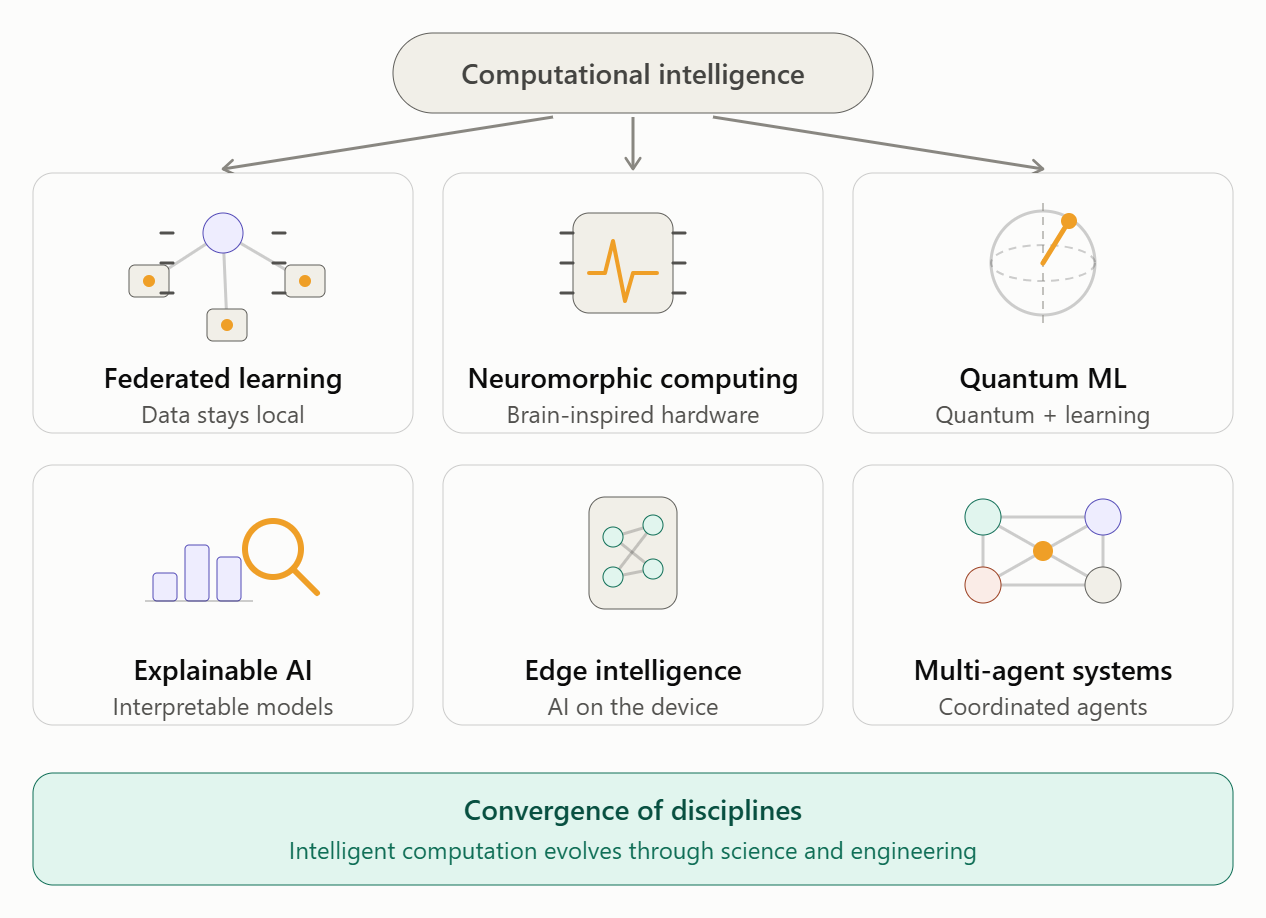
Federated Learning
Federated learning investigates methods for training machine learning models across multiple devices or institutions without requiring all training information to be centralized.
Neuromorphic Computing
Neuromorphic computing explores hardware architectures inspired by biological neural systems, with an emphasis on specialized information processing and energy efficiency.
Quantum Machine Learning
Quantum machine learning investigates the potential interaction between quantum computational methods and machine learning algorithms.
Explainable Artificial Intelligence
Explainable artificial intelligence focuses on developing methods that make computational model behavior more understandable and interpretable.
Edge Intelligence
Edge intelligence integrates artificial intelligence capabilities into devices and localized computational environments.
Autonomous Multi-Agent Systems
Multi-agent architectures involve multiple computational agents interacting to coordinate tasks, exchange information, and solve complex problems.
These research directions demonstrate how intelligent computation continues to evolve through the integration of different scientific and engineering disciplines.
Conclusion: Building the Next Generation of Computational Systems
Intelligent algorithms and emerging computational frameworks are central to the ongoing transformation of modern technological environments. Their development combines algorithmic optimization, machine learning, neural networks, distributed processing, and advanced software engineering.
The interaction between these disciplines enables the creation of computational systems capable of processing increasingly complex information and supporting sophisticated technological applications.
However, successful implementation requires more than selecting an advanced algorithm or software framework. It also involves understanding computational complexity, system architecture, data quality, hardware limitations, security requirements, and operational reliability.
As research progresses, the integration of adaptive algorithms and emerging computational infrastructures will continue to influence the development of intelligent software, autonomous systems, and advanced digital technologies.
A comprehensive understanding of these principles provides an essential foundation for exploring the next generation of computational innovation.