1. Foundations of Modern Digital Infrastructure
Digital infrastructure encompasses the hardware, software, networking, storage, and computational resources required to operate modern information systems.
Its architecture determines how technological components communicate, exchange information, process data, and coordinate different operations.
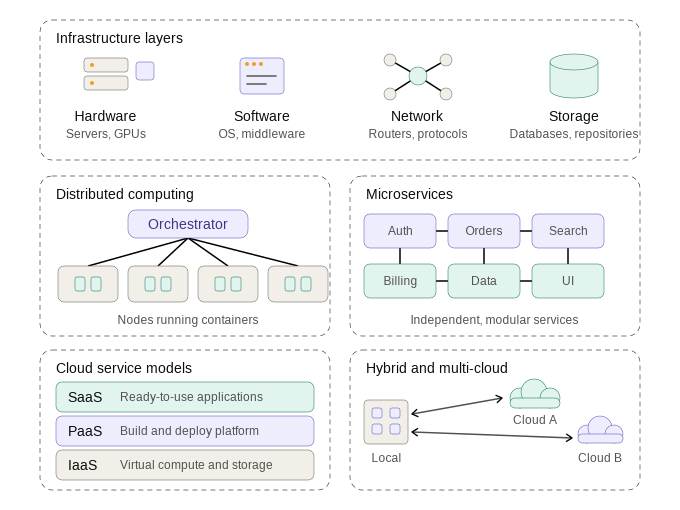
A comprehensive infrastructure generally includes several interconnected layers.
Hardware and Computational Resources
Physical infrastructure provides the processing capacity required to execute computational operations. It includes servers, processors, storage devices, networking equipment, and specialized hardware accelerators.
Modern computational environments increasingly incorporate graphics processing units and specialized processing technologies to support demanding applications such as artificial intelligence, simulation, and large-scale data analysis.
Software Infrastructure
Software infrastructure includes operating systems, application platforms, middleware, development environments, and management tools.
These components coordinate computational resources and provide the operational environment in which digital applications function.
Network and Communication Infrastructure
Communication technologies allow interconnected systems to exchange information across local and distributed environments.
Network infrastructure incorporates routers, switches, communication protocols, wireless technologies, and network management mechanisms.
Storage and Data Management
Digital infrastructures require organized storage systems to maintain, retrieve, and process information.
Databases, distributed storage platforms, and cloud-based repositories contribute to the management of large and continuously evolving datasets.
2. Distributed Computing and Infrastructure Architecture
Distributed computing is an important foundation of advanced digital infrastructure. It involves coordinating computational operations across multiple interconnected processing units rather than relying exclusively on a single machine.
This architecture allows computational tasks to be divided, distributed, and executed across different resources.
Distributed environments can improve processing capacity, support scalability, and facilitate the development of complex technological applications.
Distributed System Components
A distributed architecture commonly includes:
Computational nodes responsible for executing operations.
Communication interfaces for exchanging information.
Distributed databases for managing shared information.
Coordination mechanisms for organizing computational tasks.
Monitoring systems for evaluating operational performance.
Security mechanisms for protecting interconnected resources.
Microservices Architecture
Microservices architecture organizes applications into smaller independent services that communicate through defined interfaces.
Each service performs a specific function and can be developed, deployed, and maintained independently.
This approach supports modular software development and facilitates the integration of new functionalities into existing digital infrastructures.
Containerization and Orchestration
Containerization packages applications and their dependencies into standardized execution environments.
Container orchestration platforms coordinate deployment, scaling, networking, and resource allocation across distributed environments.
These technologies contribute to the management of complex software applications and interconnected computational services.
3. Cloud Computing and Hybrid Infrastructure
Cloud computing has significantly changed the way organizations access and manage computational resources.
Instead of maintaining all infrastructure locally, organizations can use remote platforms to access processing capacity, storage, networking, and software services.
Cloud environments provide flexibility in resource allocation and support the deployment of applications across different technological contexts.
Infrastructure as a Service
Infrastructure as a Service provides access to virtualized computational resources, including processing units, storage, and networking.
It allows developers and organizations to configure technological environments according to their operational requirements.
Platform as a Service
Platform as a Service provides development and deployment environments that simplify application management.
It can include programming frameworks, databases, development tools, and integrated software services.
Software as a Service
Software as a Service provides applications through internet-based platforms.
Users can access software functionalities without managing the underlying infrastructure directly.
Hybrid and Multi-Cloud Architectures
Hybrid infrastructures combine local computational environments with cloud-based resources.
Multi-cloud architectures use services from different cloud providers to distribute workloads and support specific operational requirements.
These approaches require careful management of interoperability, data synchronization, security, and resource allocation.
4. Autonomous Systems and Their Integration
Autonomous systems are technological environments capable of performing defined operations with limited continuous human intervention.
They combine computational algorithms, sensors, communication interfaces, control mechanisms, and automated software components.
Their integration into digital infrastructure requires coordination between physical devices and digital platforms.
Autonomous systems can be found in robotics, industrial automation, transportation technologies, smart infrastructure, and intelligent monitoring applications.
Core Components of Autonomous Systems
Sensors and Data Acquisition
Sensors collect information from physical environments. Depending on the application, they can measure movement, temperature, pressure, distance, acceleration, or environmental conditions.
Computational Processing
Processing units analyze collected information and execute computational procedures.
Decision-Making Mechanisms
Algorithmic models evaluate available information and determine suitable actions according to predefined objectives.
Control Systems
Control mechanisms translate computational decisions into operational commands.
Communication Interfaces
Communication technologies connect autonomous components with other devices, software platforms, and infrastructure resources.
5. Internet of Things and Connected Technological Environments
The Internet of Things represents an important component of modern digital infrastructure.
It involves interconnected physical devices equipped with sensors, software, and communication capabilities.
These devices can collect information, exchange data, and interact with digital platforms.
The integration of connected devices creates opportunities for developing intelligent technological environments in which information is continuously collected and processed.
IoT Architecture
A typical IoT architecture can be organized into several layers:
Perception layer: Collects information through sensors and connected devices.
Network layer: Transfers information through communication technologies.
Processing layer: Organizes and analyzes collected information.
Application layer: Provides services and functionalities based on processed data.
Device Connectivity and Interoperability
Connected environments frequently involve devices developed using different technologies and communication standards.
Interoperability is therefore essential for ensuring that these devices can exchange information and coordinate operations.
Communication protocols such as MQTT, HTTP, and CoAP support different forms of information exchange depending on application requirements.
6. Edge Computing and Intelligent Infrastructure
Edge computing introduces a distributed approach in which computational operations are performed closer to the devices generating information.
This architecture reduces the need to transfer every processing task to centralized cloud environments.
It can be particularly useful for applications requiring rapid responses, localized information processing, and efficient communication.
Edge-Cloud Integration
Edge-cloud architectures combine localized processing resources with centralized computational platforms.
Edge devices can perform preliminary data processing, while cloud environments support more demanding computational operations, large-scale storage, and advanced analytical tasks.
This distribution enables flexible resource management across different technological layers.
Benefits of Edge Computing
Reduced communication latency.
Localized information processing.
Improved bandwidth utilization.
Greater flexibility in distributed environments.
Support for real-time technological applications.
Integration with connected autonomous devices.
Intelligent Edge Systems
The integration of artificial intelligence into edge infrastructure allows certain computational models to operate directly on connected devices.
These systems can support local classification, anomaly detection, environmental interpretation, and automated monitoring.


7. Artificial Intelligence Integration into Digital Infrastructure
Artificial intelligence is increasingly integrated into modern digital infrastructures to improve computational processing, information analysis, and automated system management.
Machine learning algorithms, neural networks, and predictive models can be deployed across cloud environments, local servers, and edge devices.
Their implementation requires suitable computational resources, organized datasets, and efficient software integration.
Machine Learning Infrastructure
Machine learning infrastructure includes the computational resources and software environments required to develop, train, evaluate, and deploy models.
Its components may include:
Data collection and preprocessing systems.
Model training environments.
Computational accelerators.
Model evaluation frameworks.
Deployment platforms.
Performance monitoring tools.
Intelligent Infrastructure Management
Artificial intelligence can support infrastructure monitoring through anomaly detection, predictive analysis, and automated resource optimization.
Computational models can analyze operational information and identify patterns associated with changing system conditions.
These capabilities provide additional tools for managing complex technological environments.
Automated Resource Allocation
Intelligent resource allocation involves distributing processing capacity, storage, and network resources according to operational requirements.
Optimization algorithms can evaluate workload distribution and support more efficient infrastructure utilization.
8. System Integration and Interoperability
System integration is the process of connecting independent technological components into a coordinated operational environment.
Modern digital infrastructures frequently combine multiple applications, databases, devices, communication protocols, and software platforms.
Effective integration requires ensuring that these components can exchange information and perform coordinated operations.
Application Programming Interfaces
Application Programming Interfaces provide structured communication mechanisms between software applications.
They allow different systems to access functionalities, exchange information, and integrate external services.
Middleware Technologies
Middleware acts as an intermediary between different software components.
It supports communication, data exchange, authentication, message processing, and application coordination.
Data Integration
Data integration combines information from multiple sources into organized structures.
It may involve data transformation, validation, synchronization, and normalization.
System Compatibility
Compatibility ensures that different hardware and software components can operate together without significant technical conflicts.
It requires consideration of software versions, communication standards, data formats, and infrastructure dependencies.
9. Cybersecurity and Infrastructure Resilience
Security is an essential consideration in the development of interconnected digital infrastructures.
As technological environments become increasingly distributed, the number of communication interfaces and potential access points also increases.
Infrastructure protection therefore requires coordinated security mechanisms across hardware, software, networks, and data management environments.
Network Security
Network security involves protecting communication systems against unauthorized access, malicious activities, and operational disruptions.
Common approaches include network segmentation, traffic monitoring, secure communication protocols, and firewall configuration.
Identity and Access Management
Identity and access management establishes mechanisms for verifying users and controlling access to technological resources.
Authentication, authorization, and role-based access control help maintain structured access policies.
Data Encryption
Encryption protects information by transforming readable data into a protected representation.
It can be applied to stored information and data exchanged between interconnected components.
Infrastructure Resilience
Resilient infrastructure is designed to maintain essential operations despite technical failures or unexpected disruptions.
Redundant components, backup procedures, recovery mechanisms, and continuous monitoring contribute to operational continuity.
10. Autonomous Control and Intelligent Automation
Autonomous control systems combine computational models and control engineering to manage technological processes.
They continuously evaluate information from their environments and generate operational commands according to established control strategies.
These systems are particularly important in industrial automation, robotics, and interconnected engineering environments.
Feedback Control Mechanisms
Feedback control systems compare observed outputs with predefined objectives.
The resulting difference, known as the error signal, is used to adjust system behavior.
Proportional-integral-derivative controllers are widely used in industrial control applications.
Predictive Control
Model predictive control uses mathematical models to estimate future system behavior and determine appropriate control actions.
It is particularly relevant to systems involving multiple variables and operational constraints.
Autonomous Process Coordination
Automated coordination allows different technological components to execute interconnected operations.
This can involve scheduling, resource distribution, monitoring, and automated response mechanisms.
11. Digital Twins and Simulation-Based Infrastructure
Digital twins are computational representations of physical assets, processes, or systems.
They integrate information from sensors, databases, simulation models, and computational platforms to provide a digital representation of an operational environment.
Digital twin technologies can support system analysis, performance evaluation, and simulation-based development.
Digital Twin Architecture
A digital twin environment generally includes:
A physical system or asset.
Sensors and information acquisition technologies.
Data communication mechanisms.
A digital computational model.
Analytical and simulation tools.
Monitoring and visualization interfaces.
Simulation and Predictive Analysis
Simulation environments allow researchers and engineers to investigate how technological systems behave under different conditions.
They can evaluate possible modifications, compare operational scenarios, and identify potential performance limitations.
When integrated with real-time information, digital twins can provide more dynamic representations of physical systems.
12. Applications of Advanced Digital Infrastructure
Advanced digital infrastructure and autonomous systems integration have applications across numerous technological industries.
Industrial Manufacturing
Manufacturing infrastructures integrate automated equipment, industrial networks, intelligent monitoring, and computational control systems.
These technologies support production coordination, equipment monitoring, and operational analysis.
Smart Cities
Smart city infrastructures connect transportation systems, energy networks, environmental monitoring devices, and digital public services.
Their architecture requires coordinated information exchange and efficient resource management.
Telecommunications
Modern telecommunications infrastructures depend on distributed computing, network virtualization, automated management, and advanced communication protocols.
These technologies support connectivity and the coordination of complex network environments.
Transportation and Mobility
Autonomous and connected transportation technologies combine sensors, communication systems, computational algorithms, and control mechanisms.
Their integration supports navigation, environmental monitoring, and coordinated mobility applications.
Energy Management
Intelligent energy infrastructures combine monitoring technologies, automated control, and computational optimization.
These systems can support resource distribution, consumption analysis, and infrastructure monitoring.
Scientific and Research Environments
Advanced digital infrastructure supports computational research through distributed processing, simulation platforms, data management, and high-performance computing.
These capabilities facilitate the analysis of large datasets and complex computational models.
13. Infrastructure Performance and Optimization
The effectiveness of digital infrastructure depends on its ability to maintain operational performance while managing computational resources efficiently.
Infrastructure evaluation involves examining multiple technical indicators.
Latency: Measures the delay associated with information transmission and processing.
Throughput: Evaluates the amount of information transferred or processed within a specific period.
Scalability: Measures the capacity of an infrastructure to accommodate increasing operational requirements.
Availability: Evaluates the proportion of time during which a system remains operational.
Reliability: Examines the consistency of system performance under defined conditions.
Resource Utilization: Measures how efficiently computational resources are used.
Continuous monitoring and performance analysis allow infrastructure administrators to identify bottlenecks and optimize technological configurations.
14. Future Developments in Autonomous Digital Infrastructure
The future of digital infrastructure will be shaped by the convergence of artificial intelligence, advanced networking, distributed computing, autonomous robotics, and emerging hardware technologies.
Several developments are expected to influence future infrastructure architectures.
Intelligent Network Management
Advanced algorithms can support automated network configuration, traffic analysis, and infrastructure monitoring.
Autonomous Infrastructure Operations
Increasing automation may allow technological environments to perform more operational tasks through integrated monitoring and decision mechanisms.
Advanced Edge Intelligence
The combination of localized computing and artificial intelligence will support increasingly sophisticated processing capabilities on connected devices.
Next-Generation Communication Technologies
Emerging communication infrastructures will provide new possibilities for connecting devices, computational platforms, and autonomous applications.
Quantum and Specialized Computing
Research into quantum computing and specialized processing architectures may introduce new approaches to computational infrastructure design.
Sustainable Digital Infrastructure
Energy-efficient processors, optimized algorithms, and improved resource management will remain important considerations in the development of sustainable technological environments.
Conclusion: Toward Integrated and Autonomous Digital Environments
Advanced digital infrastructure and autonomous systems integration represent important directions in modern technological development.
Their evolution depends on the interaction between distributed computing, cloud architecture, artificial intelligence, connected devices, cybersecurity, and intelligent automation.
The integration of these technologies creates interconnected environments capable of supporting complex computational operations and sophisticated digital applications.
Successful infrastructure development requires a comprehensive approach that considers scalability, interoperability, security, performance, and operational resilience.
As technological requirements continue to evolve, integrated digital architectures will remain essential to the development of intelligent industrial environments, autonomous applications, advanced communication systems, and next-generation computational infrastructures.